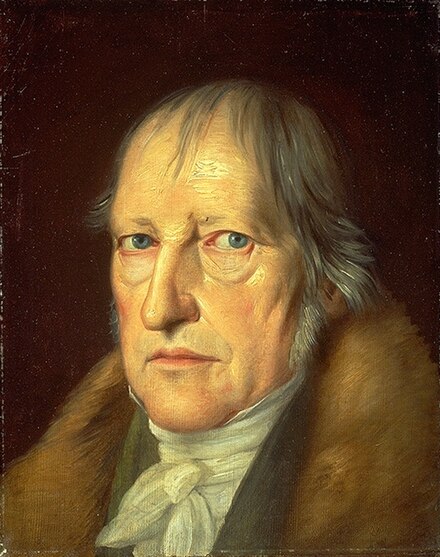
Contradiction Is the Inner Drive of All Development
Every existing thing contains its own negation; contradiction is not a defect to be eliminated but the essential force driving things toward higher forms. A thesis encounters its antithesis, and through the tension generates a higher synthesis — this movement advances the evolution of reality and thought without end.
Source: Science of Logic by G.W.F. Hegel (trans. A.V. Miller, George Allen & Unwin, 1969) / Phenomenology of Spirit by G.W.F. Hegel (trans. A.V. Miller, Oxford University Press, 1977)
What Is Rational Is Real, and What Is Real Is Rational
This proposition is not a defense of the status quo but an assertion that reason and reality interpenetrate in the historical process: history is not a heap of accidents but the process of reason (Absolute Spirit) realizing itself. To understand reality is to understand its inner rationality; to advance history is to make implicit reason manifest.
Source: Elements of the Philosophy of Right by G.W.F. Hegel (trans. H.B. Nisbet, Cambridge University Press, 1991) / Hegel: A Very Short Introduction by Peter Singer, Oxford University Press, 1983
Absolute Spirit Achieves Self-Knowledge Through History
The entire universe — nature, human society, history — is the journey of Absolute Spirit (Geist) from being-in-itself through being-for-itself to being-in-and-for-itself. Individual consciousness, national spirit, and world history are all moments in this grand movement of self-knowledge. Philosophy's task is to grasp the inner logic of this movement.
Source: Phenomenology of Spirit by G.W.F. Hegel (trans. A.V. Miller, Oxford University Press, 1977) / Hegel's Phenomenology of Spirit by Robert Stern, Routledge, 2002
Freedom Is the Ultimate Goal of History
World history is the history of the development of the consciousness of freedom: from Eastern despotism (one person free) through Greek and Roman civilization (some people free) to the Germanic-Christian world (freedom for all in law and the state). Historical progress is the realization of freedom from abstract to concrete, from the few to all.
Source: Lectures on the Philosophy of History by G.W.F. Hegel (trans. J. Sibree, Dover Publications, 1956) / Hegel's Philosophy of History by George Dennis O'Brien, University of Chicago Press, 1975
Dialectical Triad (Thesis-Antithesis-Synthesis)
Any proposition (thesis) provokes its opposite (antithesis); the two are reconciled at a higher level (synthesis), which then becomes a new thesis, driving an endless spiral of development.
In the Phenomenology, Hegel uses the master-slave relationship: the master (thesis) gains recognition through the slave's labor, but the slave (antithesis) develops self-consciousness through work, and ultimately the slave's self-awareness transcends the master's dependence, generating a new consciousness of freedom (synthesis).
Strategic AnalysisConflict ResolutionInnovation BreakthroughSystems Thinking
Sublation (Aufhebung)
Sublation in dialectical movement simultaneously means negation, preservation, and elevation — not simply overturning the old, but preserving its rational core at a higher level.
Hegel uses the relationship of art, religion, and philosophy: religion sublates art (negating its sensory form, preserving its spiritual content, elevating it to concept); philosophy sublates religion (negating its representational form, preserving its truth content, elevating it to pure thought).
Organizational ChangeTechnology IterationIntellectual EvolutionCultural Inheritance
Owl of Minerva (Historical Reflection Method)
Philosophy always arrives on the scene too late — understanding can only come after an era has run its course; thought always lags behind reality.
In the Preface to the Philosophy of Right, Hegel wrote: 'The owl of Minerva spreads its wings only with the falling of dusk.' He thereby showed that the philosophical significance of the French Revolution could only be fully grasped after its historical course had ended. Understanding reality is always retrospective work.
Historical ReviewStrategic ReflectionKnowledge ManagementPost-Decision Evaluation
Concrete Universal
True universality is not an abstract empty concept but a concrete whole enriched through the mediation of particularity and individuality.
Hegel criticized Kant's moral imperatives as overly abstract: the universal command 'do not lie' can only gain real content within concrete social relations, historical contexts, and ethical communities. Abstract universality is empty; only concretized universality is real.
Concept BuildingTheory-Practice IntegrationCross-Cultural AnalysisPolicy Making
Young Radical Period (1770-1800)
Theological critique and early political thought under the impact of the French Revolution
At the Tubingen Stift, Hegel studied alongside Schelling and Holderlin; the three famously planted a 'liberty tree' to celebrate the French Revolution. In this period Hegel wrote early theological manuscripts including The Spirit of Christianity and Its Fate, criticizing positive religion and exploring the dialectic of freedom and love, without yet forming a mature dialectical system.
System-Building Period (1801-1817)
From Jena to Bamberg, completing the Phenomenology of Spirit and Science of Logic, establishing the core dialectical framework
In 1801 Hegel joined the University of Jena; in 1807, on the eve of Napoleon's entry, he completed the Phenomenology of Spirit — calling it 'the science of the experience of consciousness.' During his subsequent tenure as headmaster in Nuremberg, he completed the Science of Logic (1812-1816), elevating dialectics to the inner structure of the universe. This was the most creatively fertile period of Hegel's philosophy.
Mature Synthesis Period (1818-1831)
Professorship at the University of Berlin, completing the Philosophy of Right, becoming the official philosopher of Prussia
In 1818 Hegel was appointed to the University of Berlin, becoming the central figure of Prussian intellectual life. In 1821 he published the Philosophy of Right, systematically expounding his theory of the ethical state. His lectures attracted students from across Europe, covering philosophy of history, religion, and aesthetics. He died suddenly of cholera in 1831; his disciples posthumously compiled and published extensive lecture notes, forming the Hegel corpus.