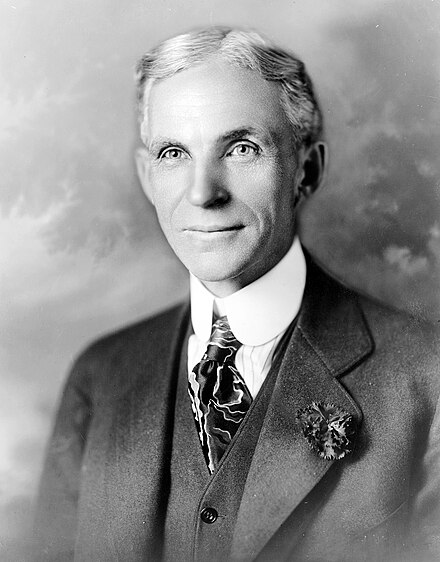
Mass Production Transforms Luxuries into Mass Necessities
Ford believed that any product that can be designed for standardization and mass production can have its price reduced to a level ordinary workers can afford. Automobiles in the 1900s were exclusively for the wealthy; Ford's mission was to ensure every worker in his factory could afford to buy a Ford automobile. This belief drove his relentless pursuit of production efficiency.
Source: My Life and Work, Henry Ford with Samuel Crowther, 1922 (Doubleday)
High Wages Are the Best Business Investment: Workers Are Consumers
Ford's Five-Dollar Day (1914) was more than double the industry average wage at the time. His logic was: high wages are not charity but business strategy—workers need high enough wages to become consumers, consumers buying goods create demand, demand expands production scale, and scale reduces costs. This logic formed the foundation of 20th-century consumer capitalism.
Source: My Life and Work, Henry Ford with Samuel Crowther, 1922 (Doubleday)
Standardization Is the Mother of Efficiency: Eliminate Variety to Achieve Ultimate Scale
Ford famously said 'any color the customer wants, as long as it is black.' This was not arrogance but the extreme embodiment of standardization philosophy: every additional variant multiplies the complexity of the entire production system, thereby driving up costs. Focusing on one product, one specification, one color in one phase is the prerequisite for achieving ultimate economies of scale.
Source: My Life and Work, Henry Ford with Samuel Crowther, 1922 (Doubleday)
Vertical Integration: Controlling Every Production Step Is the Only Way to Truly Control Cost and Quality
Ford built the most complete vertically integrated manufacturing system in human history: at the River Rouge complex, iron ore and coal went in, and complete automobiles came out. He controlled mines, steel mills, rubber plantations, glass factories, railroads, and ships. The motivation for this extreme vertical integration was: suppliers' profits are your costs, and only by controlling every link of the production chain can you truly compress costs.
Source: Ford: The Men and the Machine, Robert Lacey, 1986 (Little, Brown)
Moving Assembly Line Principle
Break work into the smallest repeating units and bring it to workers, replacing waiting with flow, compressing assembly time from hours to minutes.
After introducing the moving assembly line at Highland Park in 1913, Model T assembly time dropped from 12 hours 28 minutes to 1 hour 33 minutes; annual production leapt from 82,388 to 189,088 vehicles, while the price simultaneously fell from $850 to $360.
Manufacturing efficiency optimizationProcess standardization designScalable production system building
High Wage-High Consumption Positive Loop Model
Pay workers high enough wages to make them consumers; consumers buying goods expand the market; market expansion lowers unit costs; lower costs enable higher wages—forming a positive loop.
After the Five-Dollar Day in 1914, Ford factory annual employee turnover plummeted from 370% to 16%, productivity rose dramatically, and workers became consumers able to purchase Model T's, validating the business logic that high wages create consumer demand.
Labor relations strategyConsumer market buildingWage policy design
Extreme Vertical Integration Control Theory
By controlling every production step from raw materials to final product, eliminate supplier profit margins to achieve maximum control over cost, quality, and delivery.
The River Rouge complex was the ultimate expression of Ford's vertical integration: raw materials (iron ore, coal, timber) entered one end, and complete automobiles exited the other. The complex contained 100 miles of railroad, a massive steel mill, and glass factories; Ford even owned rubber plantations in Brazil and iron mines in Minnesota.
Supply chain strategyCost structure designManufacturing competitive strategy
Price-Cut, Volume-Scale, Cost-Reduce Flywheel
Proactively cut prices → sales surge → economies of scale → costs fall → cut prices again: use a price-aggressive flywheel to continuously expand market share and widen the cost gap from competitors.
The Model T was priced at $850 in 1908 and fell to $260 by 1924; simultaneously, cumulative sales grew from 10,000 in 1908 to 2 million in 1923. Each price cut expanded the market, the expanded market supported larger-scale production, and larger scale supported the next price cut.
Economies of scale buildingMarket share expansionCost leadership strategy
Engineer and Inventor Phase
1863-1906
Farm upbringing, Edison Illuminating Company engineer, spare-time development of gasoline engines and early automobiles
Ford grew up on a Michigan farm with a natural fascination for machinery. After entering Edison Illuminating Company as an engineer, he used his spare time to develop gasoline engines, completing his first four-wheeled vehicle (Quadricycle) in 1896. After two early company failures, he founded the Ford Motor Company in 1903 with backing from Detroit businessmen, beginning his transition from engineer to entrepreneur.
Manufacturing Revolution Phase
1906-1927
Model T, Highland Park plant, moving assembly line, Five-Dollar Day—completing the most important manufacturing innovations of the industrial revolution
This was the most glorious period of Ford's life. The Model T launched in 1908, the moving assembly line went into operation in 1913, the Five-Dollar Day was implemented in 1914, and by 1920 the Model T held more than 50% market share. In these 20 years, Ford transformed the automobile from a rich man's toy into a necessity for ordinary American families, creating the paradigm for 20th-century manufacturing.
Stubborn Conservatism and Decline Phase
1927-1947
Refusing to iterate products leading to market share loss, anti-union battles, late-life anti-Semitism stain
General Motors gradually eroded Ford's market through a multi-brand, multi-price-point strategy (Sloan's 'annual model change' concept); Ford's stubbornness with the Model T standardization model ultimately caused market share to fall from over 50% to 15%. His late-life anti-Semitic statements and violent suppression of unions became the darkest part of his historical legacy.