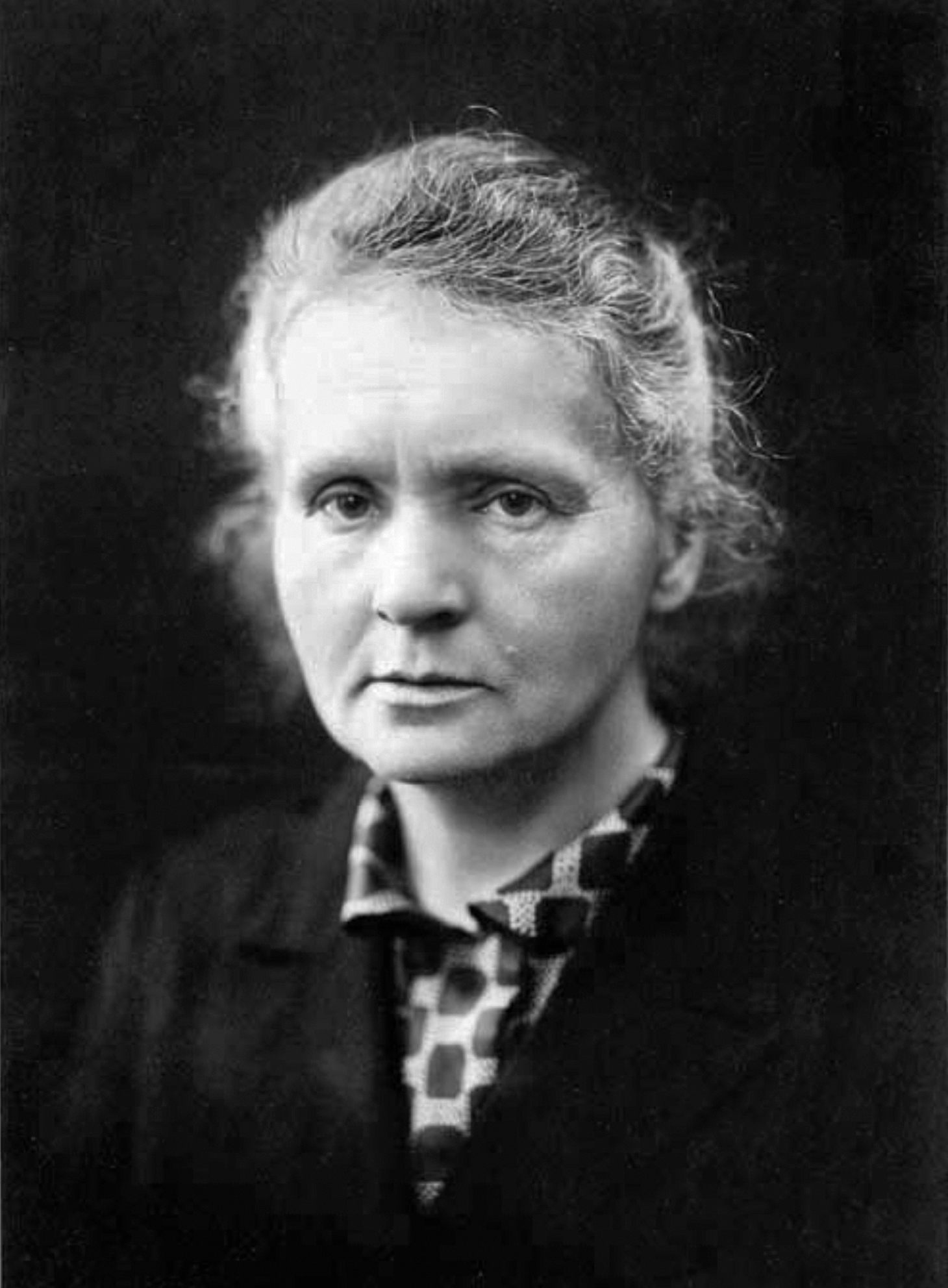
The Only Legitimate Motive for Scientific Research Is Pure Curiosity About Nature
Curie believed scientific exploration should be driven entirely by curiosity about the truth of nature, not by fame, wealth, or external pressure. She and Pierre chose not to patent the radium extraction process, freely sharing the discovery with all of humanity, believing scientific knowledge should not be private property. In her autobiography she wrote that her greatest satisfaction in life came from the laboratory work itself, not from honors.
Source: Pierre Curie (autobiography), Marie Curie, 1923 (Macmillan) / Madame Curie: A Biography, Eve Curie, 1937 (Doubleday)
Experimental Data Is the Only Arbiter of Truth; Intuition Must Yield to Precise Measurement
Curie's demands for experimental precision bordered on the exacting. To prove radium was a new element, she processed tons of pitchblende under extremely harsh conditions over four years to isolate 0.1 grams of pure radium chloride. She believed any theoretical hypothesis must be verified through reproducible, precise experiments — this conviction formed the foundation of her entire research methodology.
Source: Nobel Lecture: Radium and the New Concepts in Chemistry, Marie Curie, 1911 (Nobel Foundation) / Radioactive: Marie & Pierre Curie, A Tale of Love and Fallout, Lauren Redniss, 2010 (HarperCollins)
Systemic Prejudice Is an Obstacle to Overcome, Not a Fate to Accept
Curie faced the most severe gender discrimination in the scientific establishment of the 19th and early 20th centuries: she was twice excluded from the French Academy of Sciences (losing the 1911 membership vote by just one ballot), and the Nobel Committee initially tried to award the 1903 Physics Prize solely to Pierre — she insisted her contributions be recognized. She never publicly identified as a feminist, but demonstrated by action: the most powerful response is scientific achievement that cannot be ignored.
Source: Marie Curie: A Life, Susan Quinn, 1995 (Simon & Schuster) / Obsessive Genius: The Inner World of Marie Curie, Barbara Goldsmith, 2005 (W. W. Norton)
Scientific Knowledge Belongs to All of Humanity and Should Not Be Bound by Patents and Private Interests
The Curies explicitly declined to patent the radium extraction method, despite forgoing potentially enormous wealth. Curie believed scientific discoveries are collective achievements built on predecessors' work, and no one has the right to privatize them. During her 1921 visit to the United States, she used the one gram of radium donated by American women (worth approximately $100,000) for research rather than personal enrichment.
Source: Pierre Curie (autobiography), Marie Curie, 1923 (Macmillan) / Madame Curie: A Biography, Eve Curie, 1937 (Doubleday)
Systematic Elimination Method
By exhaustively enumerating and eliminating all known possibilities, whatever remains — however implausible — must be the truth.
When studying uranium rays, Curie found that pitchblende's radioactivity far exceeded what pure uranium could explain. She systematically eliminated all known elements as possible explanations, ultimately concluding that the ore must contain one or more unknown highly radioactive elements. This reasoning directly led to the discovery of polonium and radium.
Scientific ResearchProblem DiagnosisExploration of Unknown FieldsExperimental Design
Patient Accumulation: Achieving Qualitative Change Through Quantitative Accumulation
When a quick breakthrough is unavailable, achieve qualitative transformation through extremely patient large-scale accumulation — processing tons of raw material, repeating thousands of measurements.
To isolate enough radium to precisely determine its atomic weight, Curie spent four years manually processing over 10 tons of pitchblende residue in a ramshackle shed laboratory, ultimately obtaining about 0.1 grams of pure radium chloride. The physical demands were immense; she later acknowledged this was the most grueling period of her life.
Long-term Research ProjectsData CollectionResource-Constrained EnvironmentsTasks with Clear Goals but Difficult Paths
Interdisciplinary Bridging: Using Physics Tools to Solve Chemistry Problems
When the tools of one field are insufficient to solve a problem, proactively import the methodology of another field — the greatest discovery space often lies at disciplinary intersections.
Curie was the first scientist to systematically use ionization chambers and electrometers (physics instruments) to study the radioactivity intensity of chemical elements. She used the piezoelectric quartz electrometer invented by Pierre to precisely measure the radioactivity of various minerals — this physics measurement approach allowed her to confirm the existence of new elements before completing chemical separation, dramatically accelerating the discovery process.
Interdisciplinary ResearchInnovative MethodologyScientific DiscoveryProblem Solving
Adversity as Filter: Converting Obstacles into Focused Energy
When external circumstances (poverty, discrimination, loss) cannot be changed, convert them into extreme focus on the core goal — the greater the obstacle, the purer the focus on what truly matters.
After Pierre Curie was killed by a horse-drawn wagon on a Paris street in 1906, Marie fell into profound grief. Yet she chose to inherit Pierre's professorship at the University of Paris, becoming its first female professor, and threw herself into radioactivity research with even greater intensity — ultimately winning the Nobel Prize in Chemistry independently in 1911. This was her way of responding to life's blows through scientific achievement.
Adversity ManagementProfessional ResilienceInnovation Under Resource ScarcityLong-Term Goal Commitment
Secret Study in Poland and Journey to France (1867-1891)
1867-1891
Participated in the Flying University under Russian-occupied Poland, mutual support with sister to reach France, dual degrees in physics and mathematics at Paris Sorbonne
Born Maria Sklodowska in Warsaw, her father was a physics teacher. Under Russian occupation, Polish women could not attend formal universities; she persisted in studying through the secret 'Flying University.' She and her sister Bronia made an agreement: Bronia would study medicine in Paris first, supported by Maria's earnings, then support Maria in turn. Arriving in Paris in 1891, she studied at the Sorbonne in extreme poverty, graduating first in physics in 1893 and earning a mathematics degree in 1894. This phase forged the spiritual foundation of her persistence in learning against adversity.
Partnership with Pierre and the Discovery of Radioactivity (1895-1906)
1895-1906
Marriage to Pierre, discovery of radioactivity, discovery of polonium and radium, 1903 Nobel Prize in Physics
She married Pierre Curie in 1895, forming the most famous research partnership in scientific history. After Becquerel's 1896 discovery of uranium rays, Marie chose this topic for her doctoral research. She systematically measured the radioactivity of various minerals, finding pitchblende's radioactivity far exceeded pure uranium's, inferring the presence of unknown new elements. In 1898 she and Pierre discovered polonium (named for Poland) and radium, coining the term 'radioactivity.' In 1903 she became the first woman to earn a doctorate in France; that same year she shared the Nobel Prize in Physics with Pierre and Becquerel.
Independent Leadership and Second Nobel Prize (1906-1914)
1906-1914
Pierre's death, inheriting professorship, independent determination of radium's atomic weight, 1911 Nobel Prize in Chemistry, Langevin affair
In April 1906, Pierre was killed by a horse-drawn wagon in Paris; Marie suffered an enormous blow. She accepted Pierre's professorship at the University of Paris, becoming its first female professor, and continued deepening her radioactivity research. In 1911 she independently won the Nobel Prize in Chemistry for the discovery of radium and polonium, the isolation of pure radium, and the study of its properties — making her the only person in history to win two Nobel Prizes. That same year, the Langevin affair subjected her to intense public attack, but she insisted on attending the Stockholm ceremony and delivering her lecture.
Wartime X-ray Service and the Curie Institute (1914-1934)
1914-1934
Developing mobile X-ray units, establishing the Curie Institute, training radiological technicians, health decline in later years
When World War I broke out, Curie immediately pivoted radioactivity research toward medical applications. She designed and deployed mobile X-ray units ('petites Curies'), personally driving to the front lines to provide X-ray examinations for wounded soldiers — estimated to have saved over one million lives. After the war she focused on building and developing the Curie Institute, making it an international center for radioactivity research and training large numbers of radiological technicians. In her later years her health was severely damaged by long-term radiation exposure; she died on July 4, 1934, in Haute-Savoie, France, of aplastic anemia.